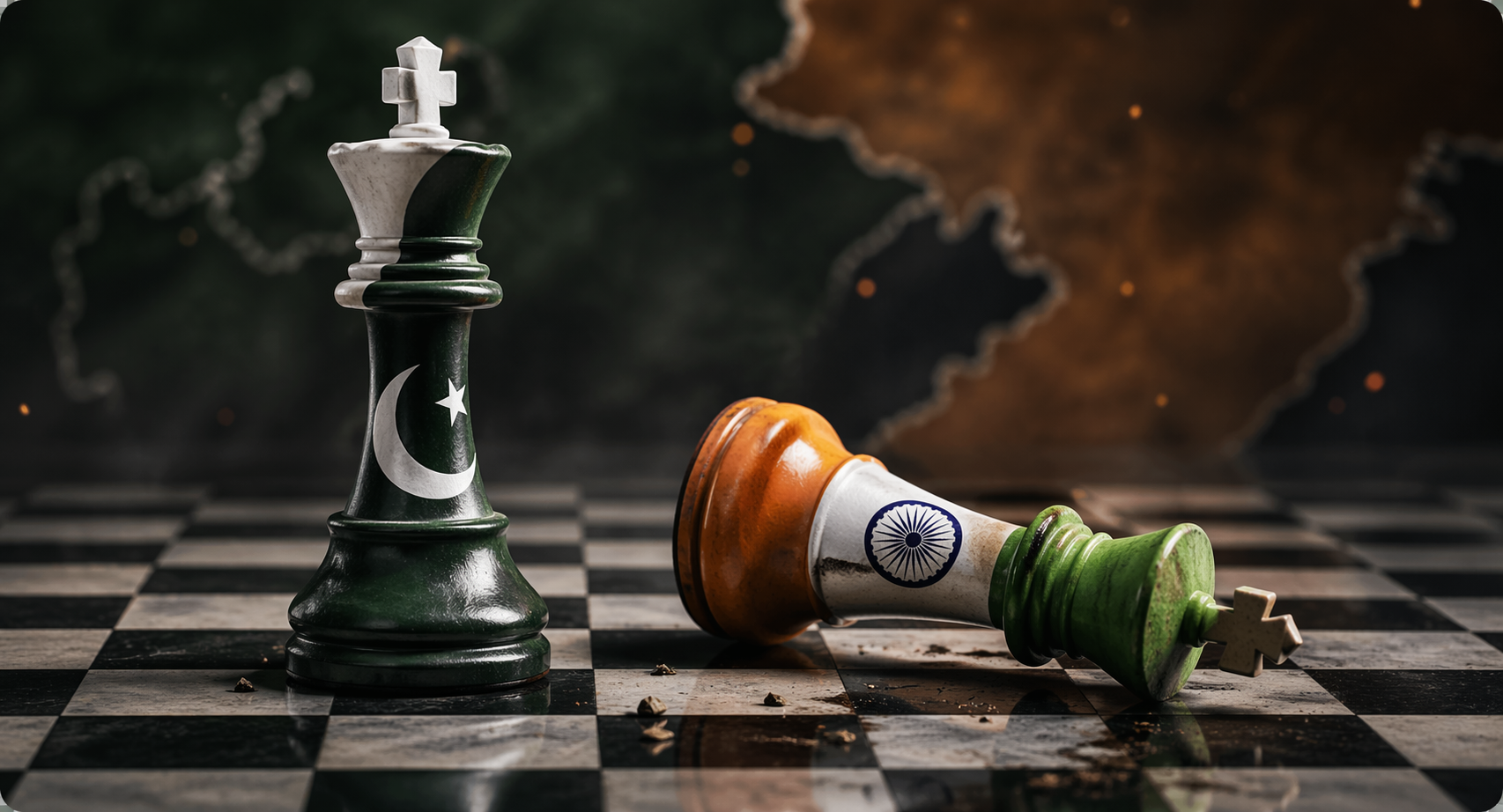
The historical animosity between India and Pakistan dates back to the partition of British India in 1947 which created two separate states on the basis of religious lines. Nevertheless, the legacy of this division was largely unfair and contested which left behind unresolved political, territorial and communal tensions (Harshe, 2005). The major among these issues is the question of Jammu and Kashmir which persistently shapes the conflict dynamics between nuclear powered Pakistan and India (Ganguly, 2001). Simultaneously, Ian Talbot (2009) defines it as an unfinished agenda of partition as it failed to reconcile the right of self-determination and principle of territorial integrity in the formal decolonization process.
In contrary, during the partition, princely state of Jammu and Kashmir was given the strategic choices of alignment to either India, Pakistan or to sought independence (Snedden, 2026). However, Jammu and Kashmir had a predominantly Muslim majority but was governed by Maharaja Hari Singh. This underscores the strategic ambiguity as it mismatches political leadership with religious demography (Jalal, 1995). Although, the princely state initially opted for independence. However, this position soon collapsed when tribal militias from Pakistan’s North West Frontier Provinces entered the Valley in Oct 1947. The tribal incursions created an instability, administrative breakdown and severe security crisis in Kashmir (Choudhury, 2013). The declining state authority prompted the Hindu monarch to accede to India in exchange for military assistance. This move instantly triggered the first Indo-Pakistani War in 1947 wherein Pakistan’s military joined tribal militias to support Kashmir’s independence (Almos, 2013). Perhaps, this conflict formally ended in 1949 with the UN brokered ceasefire that divided Kashmir among two administrative units along Line of Control (Ganguly, 1995).
Since then, both India and Pakistan have continued militarization across de-facto LoC. Concurrently, the unresolved status of Kashmir has led to major wars including 1965, 1971 and 1999 Kargil conflict (Bose, 2003). Although, the UN strongly advocated for peaceful settlement and proposed resolutions for self-determination and demilitarization. However, these efforts remained unimplemented due to lack of consensus and mistrust (Baba, 2014). Additionally, the UN has deployed United Nations Military Observer Mission in India and Pakistan (UNMOMIP) since 1947 that monitors ceasefire violations and reports to UN Secretary General. However, it lacks enforcement authority and India has rejected its mandate following the Simla Agreement 1972 (United Nations, 2025). Resultantly, Kashmir remains one of the persistent geopolitical flashpoints between nuclear powered India and Pakistan in South Asia (Bose, 2003).
In recent years, the Indo-Pak conflict over Kashmir has entered into a renewed phase of heightened tensions. The Pulwama-Balakot episode (2019) caused a major retaliatory military moves including airstrikes between the two states. However, the fragile nuclear deterrence prevented full-scale war under the stability-instability paradox (Ahmed and Ashraf, 2019). Simultaneously, India’s unilateral decision of revoking Kashmir’s special status by abrogating Article 370 has further deepened mutual hostilities. Additionally, this illegitimate demographic shift has fuelled the unrest within Kashmir itself due to concerns over political marginalization and erosion of identity (Jafferelot, 2019). It has significantly complicated the conflict resolution mechanisms for effective peace building. Indeed, it has set the stage for persistent patterns of instability and deep-seated military confrontation. Against this backdrop, the Pahalgam Crisis (2025) marks one of the most serious escalation that was dangerously close to a high-stake nuclear war (Vashishtha et al., 2025).
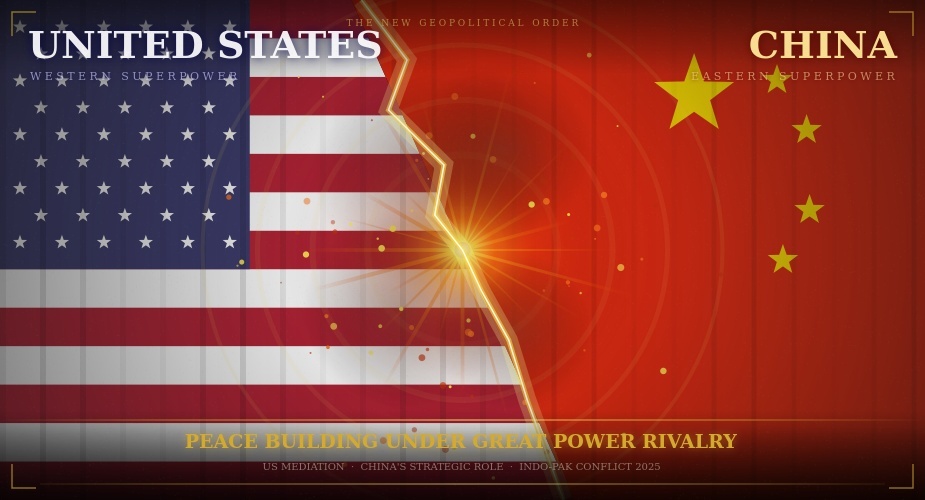
In spite of prolonged conflict management attempts, the Indo-Pak conflict over Kashmir persists and serve as a major contention in their ties. The Pahalgam crisis introduced a new dimension by drawing major powers like the United States and China whose strategic interests strongly intersect in South Asia. This study aims to examine the trajectory of peace building under great power rivalry. It explicitly focuses on the US mediation efforts and China’s strategic role in post Pahalgam crisis.
The Pahalgam Crisis (2025): A Critical Examination of Crisis Escalation Between India and Pakistan
On April 22, 2025 a high-profile militant attack in Pahalgam resulted in 26 non-muslim civilian fatalities (Panda and Pankaj, 2025). This incident marks a shift from previous terrorist activities which explicitly focused on targeting military personnel (Adil, Sohail & Farid, 2025). In the immediate aftermath, India attributed this act of terror to The Resistance Front a “Specially Designated Global Terrorist Organization” and proxy of Lashkar e Taiba. These allegations were primarily based on TRF’s anti-Indian stance and Government’s policies to non-resident settlements in Kashmir (Dasari, 2025). However, TRF strongly denied any responsibility for conducting Pahalgam attack. In the wake of this uncertainty, the Indian Army conducted Operation Mahadev and captured three LeT perpetrators directly associated with Pahalgam massacre. Meanwhile, India shifted these accusations to Pakistani based Islamist group Lashkar e Taiba and called LeT Commander Saifullah Kasuri, a mastermind in this militant activity. Simultaneously, the Indian Ministry of Home Affairs publicly declared that these attackers were holding Pakistani nationality and sought logistical support from ISI. Concurrently, India alleged Pakistan of conducting and sponsoring cross-border terrorism (Tanveer, 2025). Indian Ministry of Foreign Affairs called it biggest roadblock to peace and emphasized that the entities responsible for Pahalgam assault must be held accountable.
Pakistan categorically rejected those baseless politically motivated accusations and called for international investigation of the crisis (BBC, 2025). Pakistan refuted any connection to the defunct militant group Lashkar e Taiba and condemned all forms of terrorism itself. Indeed, Pakistan declared itself as a victim of terrorism for decades (Hassan, 2025). Pakistan’s Defense Minister warned about all-out military war amid any Indian retaliation on Pakistani territory. Meanwhile, India’s immediate suspension of the Indus Waters Treaty was declared as a blatant act of war by Pakistan (Khandekar, 2025). Tactical communion channels such as DGMO hotlines were still opened to avoid miscalculations. However, air diplomacy was halted. Meanwhile, cross-border skirmishes and ceasefire violations were repeatedly observed across Line of Control (Joshua, 2025). The persistent ceasefire violations gradually translated into structured military operations under limited war.
Operation Sindoor
On May 6, 2025 India launched Operation Sindoor, a precision strike military response amid Pahalgam assault. Under this operation India conducted strikes on Pakistan administered Kashmir and mainland Pakistan by using BrahMos Crisis Missiles and Rafale jets (Ramachandran, 2025). According to Indian defense sources, the operational rationale was to neutralized militant infrastructure related to Lashkar e Taiba and Jaisha e Muhammad. Indian sides framed it as counter terror operation and claimed that they successfully targeted 9 terrorist sites (Hussain, 2025). Within just 36 hours of Operation Sindoor India launched nearly 80 drones into Pakistani territory.
Pakistan rejected India’s terror only target campaign and argued that Indian strikes targeted non-military civilian infrastructure. In immediate response to Operation Sindoor, Pakistan shot down 5 Indian fighter jets and neutralized numerous drones (Shahzad and Patel, 2025). However, on May 10 Indian BrahMos Supersonic missiles and drones targeted Nur Khan, Murid and Rafiqui air bases in Pakistan (Shah and Shahzad, 2025). In response, Pakistani authorities announced a military operation against Indian facilities (Malik, 2025).
Operation Bunyan ul Marsoos
On May 10, 2025 Pakistan launched a retaliatory military operation Bunyan ul Marsoos also known as Marka e Haq (Hussain, 2025). Under this operation Pakistan targeted multiple Indian military installations including Udhampur, Pathankot, Adam Pur and Bhij airbases. This operation was executed by using Fath II missiles and fighter jets (Yang and Fultun, ,2025). Alongside missile strikes Pakistan also launched numerous drones into Indian territory ( Greenfield and Patel, 2025). It was framed as a defensive response to Operation Sindoor.
Patterns of Escalation and Strategic Constraints
The military crisis that began with a terror attack on Pahalgam followed a counter retaliatory military operations by India and Pakistan. It strongly exhibits the logic of integrated conventional escalation. This means that the crisis escalated intensely because it involved multidimensional confrontation however, it remained under the nuclear threshold (Newman, 2025). Therefore the pattern of escalation indicates relative stability due to strategic constraints under nuclear deterrence as both sides avoided full scale nuclear war. Additionally, the avoidance of strategic level war was influenced by external crisis management intervention by great powers (McClafferty, 2026).
Role of Great Powers
Role of US
The US played a major role in brokering a ceasefire between India and Pakistan during the crisis. The US role reflects the operationalization of brokered bargaining that refers to a three pronged bargaining mechanism (Newman, 2025). In essence, it revolves around the idea that involves a crisis situation between two nuclear rivals where an external power intervenes and promotes de-escalation of crisis (Yousuf, 2025). Following the Indo-Pak tit for tat military retaliation, the Trump administration was involved in high-level communication with military officials from both sides to end hostilities. Simultaneously, military officials from belligerent sides got engaged in the DGMO hotline communications and agreed to temporary ceasefire. Similarly, on May 10 the Indo-Pak ceasefire was officially announced (Bhardwaj, 2025).
Role of China
In the Indo-Pak military crisis, China’s approach reflect diplomatic posturing rather than a direct mediator. It publicly promoted de-escalation and proposed conflict resolution through constructive dialogue (Yousaf, 2025). Additionally, Chinese officials engaged in high-level diplomatic communications with Pakistan and called for neutral international investigation of the crisis to prevent miscalculations. Simultaneously, China showed strategic alignment towards Pakistan that was fundamentally driven by economic investments related to CPEC (Pankaj and Bhole, 2025). For this purpose, China provided Pakistan with military assistance including fighter jets and advanced missile capabilities to intercept incoming Indian missile and jets (Bukhari, 2026).
Analysis of Peace Building under Great Power Rivalry
The Peace Building in May 2025 crisis was shaped by great power involvement. This Peace process increasingly operated under Great power rivalry as both powers pursued competing and interest driven strategic goals (Pervaiz, 2025). Initially, the US showed reluctance to the crisis management (Clary, 2025). However, after Pakistan’s retaliatory military operation wherein Indian military facilities were severely targeted the US intervened through back channel diplomacy and pressurized belligerent parties to prevent escalation (Bhardwaj, 2025). Within the broader framework of Indo-Pacific strategy the US views India as a strategic partner in balancing China’s phenomenal rise. The US crisis management diplomacy was aimed at preventing India from being dragged into a costly war (Yosuf, 2025). This could allow China in gaining regional influence and shifting a balance of power in its own favour (Alan, 2025). In short, the US involvement reflects the logics of offshore balancing. This involves the US diplomatic engagement during the regional contingency that is aimed at preserving regional balance while also safeguarding the stability of its regional ally which is central to containing China (Clary, 2025). Therefore, the US role as a neutral mediator is significantly limited given its strategic partnership with India.
In the post-Pahalgam crisis, China’s approach underscores a dual track strategy. Although, China avoided direct engagement in US brokered ceasefire negotiations (Pervaiz, 2025). Nevertheless, China promoted diplomacy of peace and publicly called for restraints (Yousaf, 2025). Simultaneously, China showed strategic alignment towards Pakistan that was shaped by its ironclad friendship and economic investments as part of BRI (Pankaj and Bhole, 2025). These investments are seen as the part of China’s strings of pearl strategy through which China aims to establish a network of strategic ports to encircle India across the Indian Ocean to gain regional strategic influence. Hence, in response to growing Indo-US cooperation China leveraged diplomatic and military support to Pakistan to preserve its geopolitical interests and rapidly pacing regional influence (Bukhari, 2026). In addition, China’s strategic influence in the region has significantly enhanced following the Indo-Pak crisis, notably through the expansion of defence cooperation and arms transfers with regional states. It has emerged as the largest supplier of sophisticated military weapons such as J-10C fighter aircraft and JF-17 Thunder jet, drones, missile systems, and integrated air defence technologies to regional countries (Ahmad, 2025). This surging defence cooperation underscores a broader pattern of China’s arms penetration in South Asia, wherein defence exports are interpreted as a key instrument of strategic influence.
Conclusion
The May 2025 crisis between India and Pakistan illustrates that the Kashmir issue remains one of the most persistent flashpoints in South Asia as it continues to generate the recurring patterns of escalation. This military crisis began with a false flag terrorist attack on Pahalgam that immediately followed counter retaliatory military operations strongly demonstrates the endurance of crisis-driven strategic environment under the nuclear threshold. The findings of the study reveals that pattern of this crisis exhibits the logic of integrated conventional escalation wherein both states avoided full-scale nuclear war. It further reveals that external intervention for crisis management was largely driven by geopolitical interests. Therefore, in this form of competitive peace management neither great power addresses the core Kashmir issue.
This study, therefore recommends that external mediation efforts must be neutral and focused on addressing the root causes to prevent the patterns of future instability. The role of United Nations must be strengthened by reinforcing enforcement authority of United Nations Military Observer Group in India and Pakistan. Additionally, it advocates for establishing institutionalized crisis communication mechanisms between belligerent parties to reduce miscalculations during the phase of escalation. The confidence building measures such as ceasefire monitoring mechanisms and military hotlines must be strengthened. Sustained diplomatic engagement must be ensured to build trust and to prevent complete breakdown of dialogue during the crisis.
References
Adil, J. Z., Sohail, M., & Farid, S. (2025). Pak-India War Crisis: A Historical and Strategic Analysis. The Critical Review of Social Sciences Studies, 3(3), 131-144.
Ahmad, U., & Begum, A. (2026). Operation Sindoor and the 2025 India Pakistan Conflict: Strategic Escalation and Regional Stability. VFAST Transactions on Education and Social Sciences, 14(1), 17–30. https://doi.org/10.21015/vtess.v14i1.2408
Baba, N. A. (2014). Resolving Kashmir: imperatives and solutions. Pervaiz, Sannan . “China’s Role in the May 2025 India-Pakistan Conflict: Strategic and Global Implications.” August 1, 2025. 56(2), 66-80.
Dr. Mansoor Ahmed, & Maimuna Ashraf. (2019). The Pulwama-Balakot Crisis: A Strategic Assessment. CISS Insight Journal, 7(1), 01-24. https://journal.ciss.org.pk/index.php/ciss-insight/article/view/1
Tanveer, A.(2025).From Ganga to Pahalgam: India’s Arc of Strategic Deceit. Policy Perspectives, 22(1).
GANGULY, S. (1995). Wars without End: The Indo-Pakistani Conflict. The ANNALS of the American Academy of Political and Social Science, 541(1), 167-178.
Harshe, R. (2005). India-Pakistan Conflict over Kashmir: Peace through Development Cooperation: Peace through Development Cooperation. South Asian Survey, 12(1), 47-60.
Kokab Saeed, Nadir Ali Khan, Irshan Arif, Dr. Amjad ur Rehman, Misbah Rehman, & Navishta Maheen. (2025). FROM PAHALGAM TO CEASEFIRE: THE 2025 INDIA–PAKISTAN CONFLICT, ITS HISTORICAL ROOTS, AND DONALD TRUMP’S MEDIATION ROLE. Pakistan Journal of Social Science Review, 4(4), 1173–1204. https://www.pjssrjournal.com/index.php/Journal/article/view/175.
Pervaiz, Sannan . “China’s Role in the May 2025 India-Pakistan Conflict: Strategic and Global Implications.” August 1, 2025.
Ramachandran, S. (2025). ‘Operation Sindoor’: Will India’s Military Strikes in Pakistan Curb Cross-Border Terrorism? Counter Terrorist Trends and Analyses, 17(4), 8–15. https://www.jstor.org/stable/48827115.
Snedden, C. (n.d.). Maharaja Hari Singh and his accession issue. In Independent Kashmir: An incomplete aspiration (pp. 44–92). Chapter, Manchester University Press.
Vashishtha, K., Dhankar, C., Tripathi, S., & Joshi, R. (2025). Pahalgam attack: a reflection of escalating tensions in South Asia’s geopolitical landscape. The Round Table, 114(3), 329–331. https://doi.org/10.1080/00358533.2025.2504595